The Shaga Model: Dual Revenue. One Network.
Shaga turns idle gaming PCs into a low-latency network that powers play and generates premium AI training data. Dual revenue from one network.
Key Points
- Early DePIN scaled supply without proven demand, leaving networks underused.
- Idle gaming PCs power low-latency play while generating AI training data, dual revenue from one network.
- No data centers. Capital-efficient edge computing with sub-40 ms latency in metro areas.
- Cash flow from subscriptions and data licensing funds network growth and ecosystem incentives.
This article outlines Shaga’s forward-looking model and vision. The mechanics described are not yet live but represent the intended design.
The Cloud Gaming Dilemma: Capital vs. Demand
Cloud gaming sits at the intersection of two broken business models:
The centralized approach: Companies like Google Stadia bet on massive data center build-outs to deliver AAA gaming. The bet failed. Stadia shut down in 2023 after struggling to convert infrastructure spending into sustainable revenue. The core problem: high fixed costs funded entirely by subscriptions, with no secondary revenue stream to offset losses.
The DePIN approach: Decentralized infrastructure networks took the opposite bet: incentivize supply first, find demand later. Helium pioneered this model, successfully deploying tens of thousands of nodes through token incentives. As Blockworks noted, the first-generation approach prioritized infrastructure deployment, with usage revenue following later. This established a category-defining playbook for decentralized networks.
The market has a gap: Where is the cloud gaming platform with both capital efficiency and real revenue from day one?
Shaga addresses this gap. We’re building a platform that turns idle community hardware into dual revenue streams: subscriptions and data licensing. The model is designed for usage-driven economics.
Capital Efficiency: Community Hardware Over Data Centers
We operate on a simple principle: workloads should fund the network, not upfront infrastructure spend. Rather than building data centers, we activate underutilized GPUs already sitting in millions of gaming PCs worldwide. This community-run edge targets low-latency, near-device responsiveness without the capital burden of centralized infrastructure.
Dual Revenue: Gaming Meets AI Data Licensing
Capital efficiency solves half the equation. The other half is revenue depth.
Shaga generates cash flow from two streams:
- B2C subscriptions from gamers and creators using the platform
- B2B data licensing to AI labs, training world models on authentic human gameplay
We anticipate the B2B line will carry higher margins than subscriptions in the near term. By anchoring value in operating cash flows from both streams, the model reduces reliance on token speculation and creates sustainable unit economics from day one.
How It Works: Instant Access, Zero Friction
- Gamers without a high-end PC launch top-tier titles on any device and jump into friends’ sessions via QR code or invite link. Latency often feels local, with benchmarks under 40 ms in supported metros (actual results vary by network).
- Streamers turn one-way broadcasts into interactive co-play: spin up a lobby, invite viewers to join, and pass control with “Controller Rotation” so anyone in chat can play. Deeper engagement keeps viewers on-platform longer.
Under the hood, DePIN edge nodes provide the compute power. When hosts enable data capture, authenticated gameplay feeds the B2B data business, linking usage directly to revenue.
Community‑Powered Growth: Player‑Hosted Lobbies
Shaga grows through player-hosts who spin up lobbies on their own gaming PCs. Friends and viewers join via invite link with minimal friction. Up to four players can co-play in each session.
Streamers amplify this model with Controller Rotation, turning spectators into active participants. This community-led growth complements paid acquisition and scales coverage organically with each new host.
The Data Dividend: Gameplay for AI
The AI Demand:
World models are where language models were in 2020. GPT-3 launched that year; by 2025, billions are flowing into GPT-4, Claude, and Grok. The same trajectory is now unfolding for interactive AI: Google’s Genie 3 launched in August 2025, and every major AI lab is racing to build systems that generate playable environments from text prompts.
The Data Bottleneck:
While AI labs have deep funding, the critical constraint is data. World models need millions of hours of authentic, human gameplay—not synthetic or scripted interactions. This dataset can’t be fabricated; it requires distributed infrastructure to capture at scale. That’s the bottleneck slowing progress across the entire category.
From these sessions, Shaga cultivates precisely that asset: a continuous stream of consented, authenticated gameplay data.
The Shaga Advantage:
Our analysis of AI data requirements indicates that peer-to-peer cloud gaming solves this problem architecturally. Remote connections decouple gamers from hardware - a single GPU can serve dozens of real players daily, each contributing unique behavioral patterns. This generates exponential gameplay throughput: fidelity that synthetic methods can’t replicate, efficiency that annotation farms can’t match.
This architecture represents a unique topology that compounds human signal with infrastructure leverage. Opt-in hosts are rewarded when data meets quality standards, captured with consent and verified on-chain for enterprise-grade provenance.
The Flywheel: How Growth Reinforces Itself
The Shaga flywheel is structured as a cause-and-effect loop. Each stage is designed to feed the next, reinforcing defensibility over time.
1. User Growth Increases Node Density: As more gamers and creators join, the geographic density of active nodes increases. Physical proximity is associated with lower latency, which can improve responsiveness.
2. Lower Latency Drives Engagement: Industry benchmarks indicate that lower latency is associated with longer sessions, higher retention, and better viewer-to-player conversion. This deeper engagement, when captured by participating hosts, generates a greater volume of gameplay datasets.
3. Engagement Growth Fuels Dual Revenue: We expect the expanding data pool to strengthen the B2B line while user growth increases the B2C subscription base.
4. Revenue Funds Network Incentives: We plan to allocate cash flow to strategic reserves that attract more node hosts, strengthen network infrastructure, and improve the platform, with the goal of catalyzing the next growth cycle.
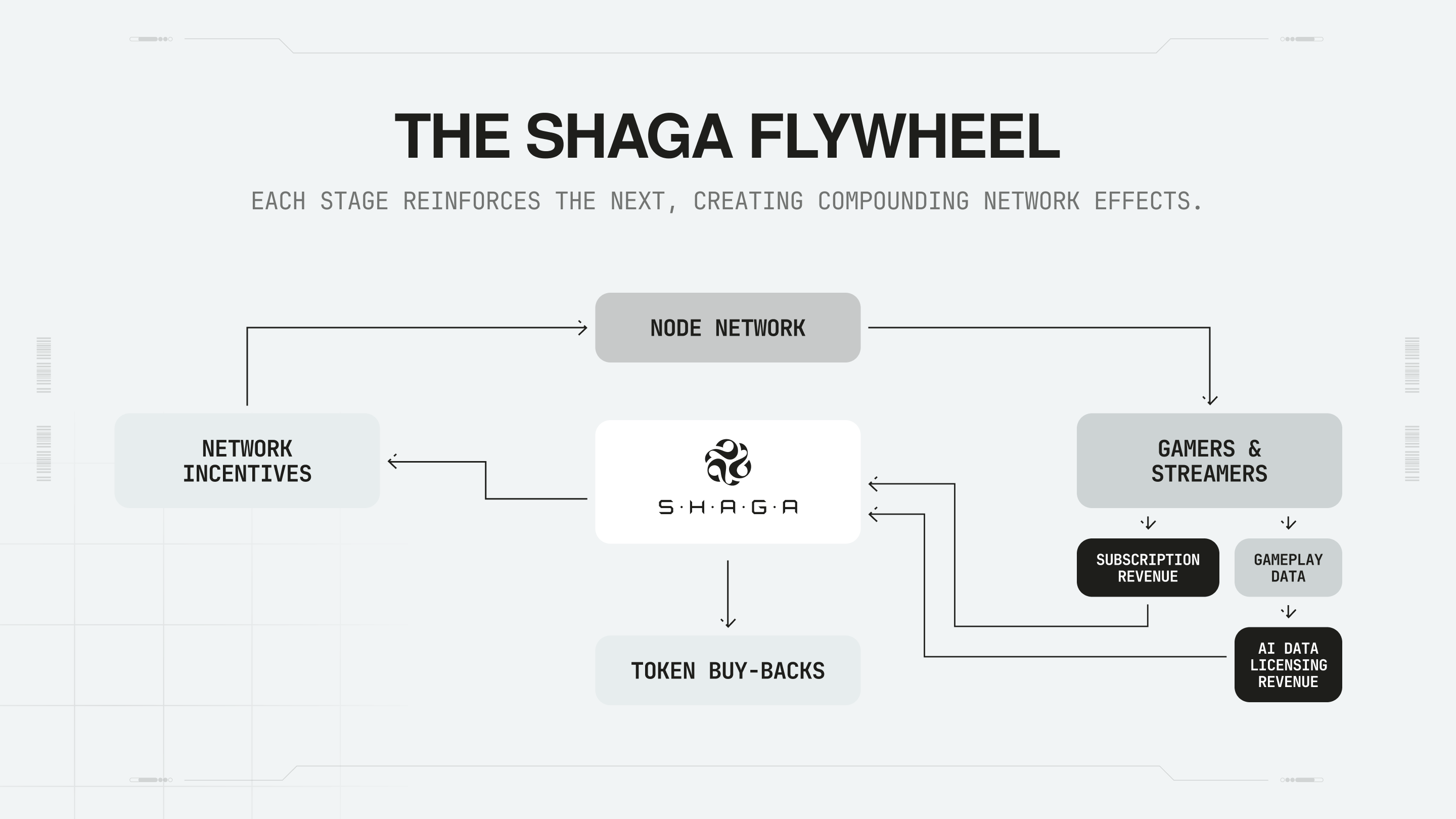
In summary: More Hosts → Better Performance → More Players → Dual Revenue (Subscriptions + Data) → Funds Network Growth & Incentives ↻
This is expected to create durable network effects. Each new user can increase value for the next, compounding over time.
Two Revenues and Network Effects
The cloud gaming market is stuck between two flawed models. Shaga presents the synthesis: a platform that combines the capital efficiency of distributed infrastructure with high-value, revenue-generating workloads. This model is designed to build a defensible business around recurring revenue and advance the new category of AI Gaming Infrastructure. We believe now is the moment to build network effects and data moats ahead of broader market consolidation.
Over the next phase, gameplay datasets will train Shaga’s generative engine, enabling us to pursue publishing AI-authored “living” games on the network. We aim to explore this as generative models mature and adoption validates the approach. This self-refreshing content pipeline is expected to deepen engagement and strengthen the data moat over time.
We are now engaging with strategic partners who recognize this opportunity and share a long-term vision for the future of interactive entertainment and AI.
Disclaimer: This analysis discusses Shaga’s platform architecture, business model, and market positioning - intended for informational and educational purposes, not for solicitation or investment promotion.